Hybrid Photoelectrodes and Rationally Designed Surface Chemistries
Si-N bond-forming surface chemistries
We demonstrated the first examples of functional (photo)electrodes prepared with Si-N bonds prepared through nitrocyclocondensation (NCC) and photolyzed azide (single nitrene) reactions on Si-H surfaces. These chemistries form sub-monolayers, which are ideal and challenging for elucidating structure-reactivity relationships.
We continue to focus on NCC chemistries, to:
Improve surface coverages with NCC reactions, exploring the reactivity space of nitro vs. nitroso functional group reactivity with Si surfaces.
Nanoscale mapping of work function on (photo)electrodes to quantify the effects of molecule-induced band bending and determine the size of unreacted surface sites (causing parasitic H+ reduction sites).

(Photo)electrocatalysis in polymeric films
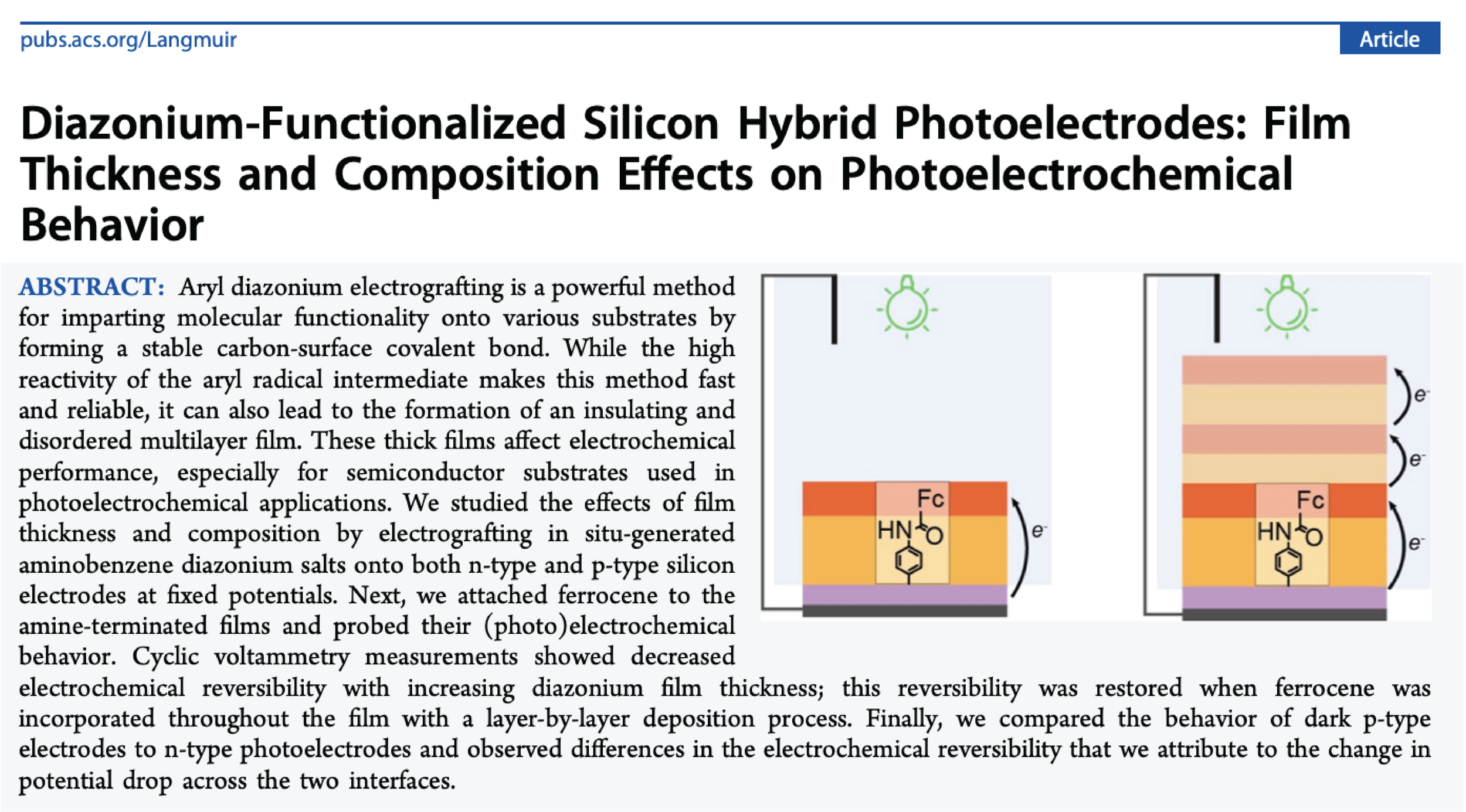
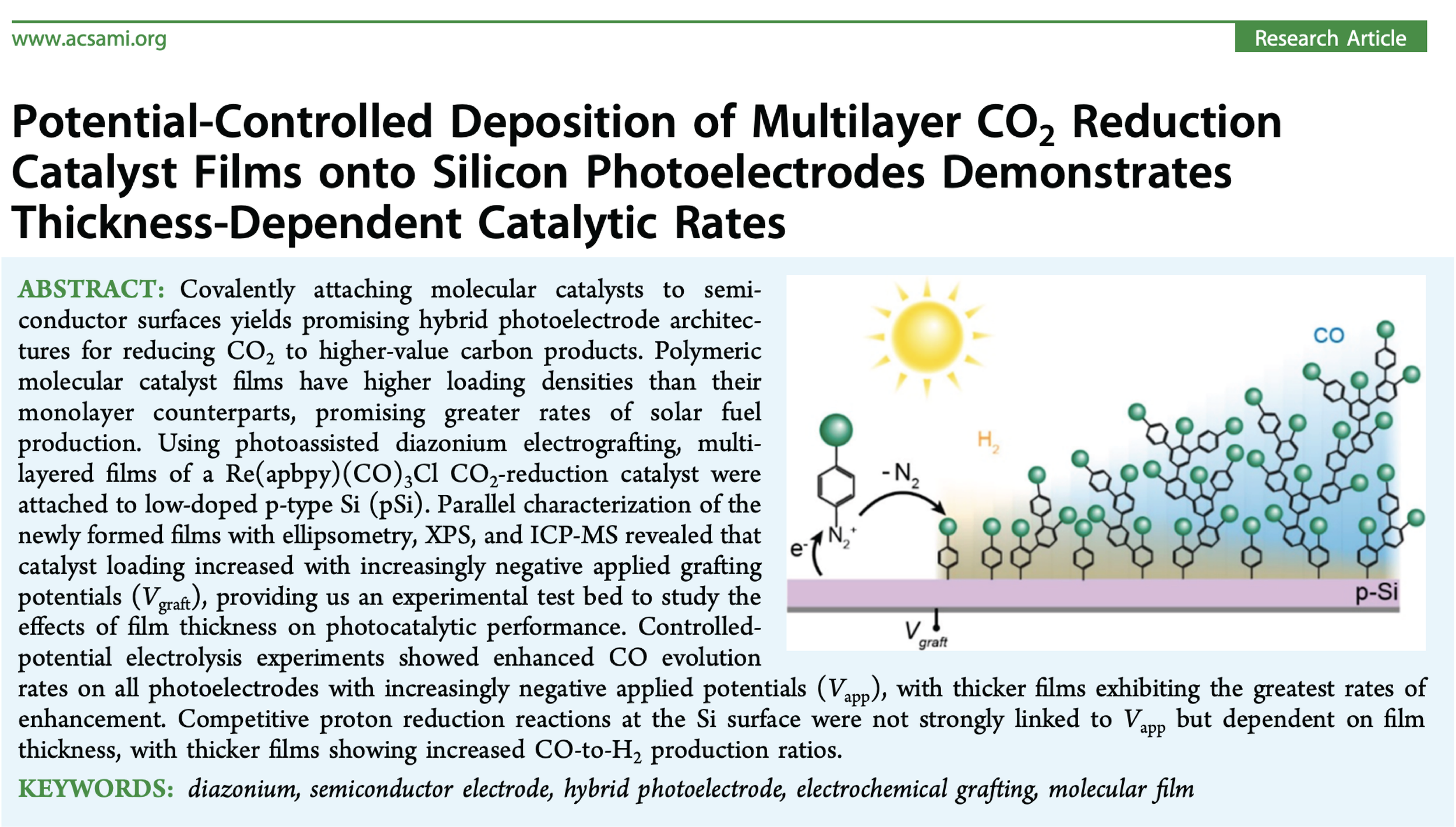
The efficiency of catalyst-containing polymer films deposited on an electrode depends on: 1) electron diffusion through the film, 2) substrate diffusion through the film, and 3) the reaction rate of the catalyst. The number of photogenerated electrodes can also limit these reactions, but this effect is only relevant in hybrid photoelectrode configurations. We have demonstrated the efficiency of charge transfer through aryl diazonium electropolymerized films with redox reporters and catalytic efficiency with similar films containing a Re-centered CO2 reduction catalyst
Where are we going next?
Using computationally directed predictions, install fluorinated aryl diazonium films of defined structure and thickness to prevent unwanted H+ reduction reactions at the Si electrode surface.
Determine and overcome the limitations of the film’s ability for CO2-to-CO conversions (e.g., electron relays, defined pore sizes).
Explore alternative films, including molecularly imprinted polymers and hydrogel entrapment methods.
C-on-Si photoelectrodes
Silicon is an excellent photoelectrode material. Hybrid photoelectrodes on silicon can suffer from its propensity to oxidize under ambient and operating conditions for CO2 reduction. Molecular or nanometer-thick conformal coatings are two strategies to prevent Si from forming a native oxide (~3 nm).
Nanometer-thick C films can be pyrolyzed on Si. These films exhibit 200+ mV photovoltages and fast electron-transfer kinetics across a wide range of reducing potentials.
Our goals in this ongoing area include:
Tuning the optical and electronic properties of the carbon films .
Installation of CO2 molecular catalysts on the surface and measurements of performance under illumination.